
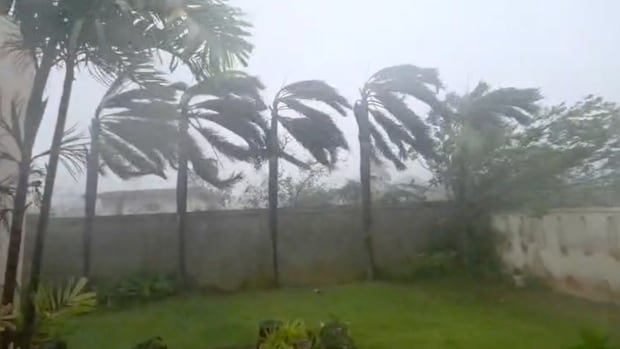

A powerful super typhoon relentlessly pummeled two remote U.S. islands in the Pacific Ocean with fierce winds and heavy rains, causing widespread damage to buildings and forcing residents to seek shelter from flying debris.
Super Typhoon Sinlaku battered the Northern Mariana Islands throughout the night into Wednesday morning, wreaking havoc on the islands of Tinian and Saipan, which are home to nearly 50,000 people.
Glen Hunter, a Saipan native, observed multiple tin roofs being ripped off by the strong winds, expressing that structures made of wood and tin likely did not withstand the storm. He described the relentless rain seeping into every corner of his concrete home, making it a challenging situation for residents.
The tropical cyclone, considered the most potent in the world this year, made landfall on the islands with sustained winds reaching up to 240 km/h, as reported by the U.S. National Weather Service.
Apart from the Northern Mariana Islands, Guam, a U.S. territory to the south with significant U.S. military presence and around 170,000 residents, also experienced tropical force winds and flash flooding, creating challenging conditions for the residents and emergency responders.
Mayor Ramon (RB) Jose Blas Camacho of Saipan highlighted the difficulties faced by the community in responding to the storm’s impact, with heavy rain and strong winds causing widespread destruction and posing risks to residents’ safety.
Super typhoons, equivalent to Category 4 or 5 hurricanes in the Atlantic, are not uncommon in the Pacific region, with over 300 identified by the Joint Typhoon Warning Center in Guam in the past 80 years. The recent storm, Sinlaku, slowed down significantly as it approached the islands, intensifying the potential for extensive damage.
As the situation unfolded overnight, meteorologists warned of an arduous night for residents across the affected islands, emphasizing the need for preparedness and caution. The storm, although expected to weaken slightly in the coming days, maintained its intensity as a Category 4 typhoon during its passage through the region.
In response to the impending disaster, U.S. President Donald Trump approved emergency disaster declarations for Guam and the Mariana Islands, facilitating coordinated support efforts by various agencies including FEMA, which deployed personnel to assist in the aftermath of the storm.