
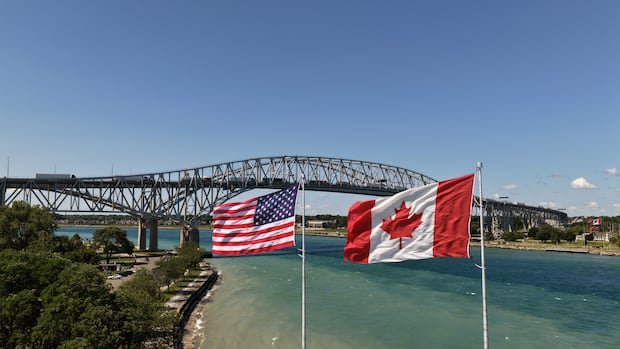

Following the return of Canadian negotiators and the implementation of 50 per cent U.S. tariffs, the Canadian business community is assessing the potential impact of these new levies.
Various business leaders involved in exporting products like plywood and wine are now confronted with these tariffs, indicating that the high rates could effectively sever ties with the United States.
What remains to be seen is the extent of the blow to the overall economy, the sectors most vulnerable to these tariffs, and the potential repercussions on Canadian employment. Here are the key insights you should be aware of.
Economic Impact: BMO Forecasts GDP Reduction
The newly imposed 50 per cent tariffs apply to a diverse range of products, encompassing approximately $28 billion worth of Canadian exports to the U.S.
Although this figure represents only about five percent of Canada’s total exports to the U.S., BMO’s senior economist, Robert Kavcic, emphasizes that the tariffs could dent Canada’s GDP growth by half a percentage point. This forecast stems from the notion that the new tariff structure might discourage businesses from making investments that would otherwise contribute to economic expansion.
Moreover, these tariffs arrive at an unfavorable juncture, coinciding with a period when Canadian economic growth was showing signs of improvement after a sluggish start to the year.
Industry-Specific Impact
While the aggregate impact may appear modest on a national scale, certain industries will bear the brunt of the tariffs due to their concentrated exposure.
According to export data from the United States International Trade Commission analyzed by CBC, sectors such as electronics and electrical equipment will be most severely affected by the tariffs. The analysis reveals that in 2025, Canada exported over $4 billion worth of electronic equipment subject to the new tariffs.
Plastics rank second on the list, followed closely by furniture, bedding, lighting, industrial machinery, and paper products. Notably, the manufacturing of these goods predominantly occurs in Ontario and Quebec, making these provinces particularly vulnerable to the tariff repercussions.
British Columbia is also significantly impacted, especially due to its heavy reliance on paper and wood exports, which now face tariffs amounting to over 13 percent of the province’s total exports to the U.S.
Effect on Small Businesses
Aside from major manufacturing sectors, the newly tariffed items encompass a variety of consumer products like honey, candles, and hockey sticks.
These products, often exported by smaller Canadian enterprises, could be easily substituted with American alternatives. Consequently, smaller businesses lacking significant financial reserves to weather such challenges may experience a disproportionate impact. The Canadian Federation of Independent Business (CFIB) discovered that 40 percent of its exporting members are affected by the tariffs.
Notably, 35 percent of surveyed small and medium-sized business owners foresee a revenue decline of at least 50 percent due to the tariffs, while 78 percent anticipate their products becoming uncompetitive in the U.S. market.
Job Loss Estimates
According to University of Calgary economics professor Trevor Tombe’s recent analysis, tens of thousands of jobs in Canada are at risk due to the new tariffs.
Tombe estimates that around 52,000 jobs in affected sectors are under threat, with an additional 35,000 jobs at risk in industries supporting the tariff-affected sectors. This ripple effect could result in a total of 87,000 estimated job losses.
Furthermore, the repercussions of the tariffs extend beyond Ontario, Quebec, and B.C., with Alberta facing potential job losses of about 9,000 due to its involvement in supporting export industries affected by the tariffs.
Impact of Uncertainty
While the direct impact of tariffs will be sector-specific, a significant Canada-wide risk posed by the tariffs is uncertainty.
University of Calgary’s Trevor Tombe highlights that the uncertainty surrounding the tariffs could have a more profound economic slowdown effect than the tariffs themselves. The ongoing trade tensions have created uncertainty since the inception of the U.S.-Canada trade conflict, and the breakdown of negotiations has only exacerbated the situation.
The looming threat of retaliatory tariffs adds to the uncertainty, with Prime Minister Mark Carney pledging reciprocal tariffs, raising questions about potential retaliatory measures from the U.S. This unpredictability could further escalate the trade dispute, potentially impacting various industries and provinces across Canada.
Given the prevailing uncertainties and the escalating trade tensions, businesses may adopt a cautious approach towards hiring and investment