
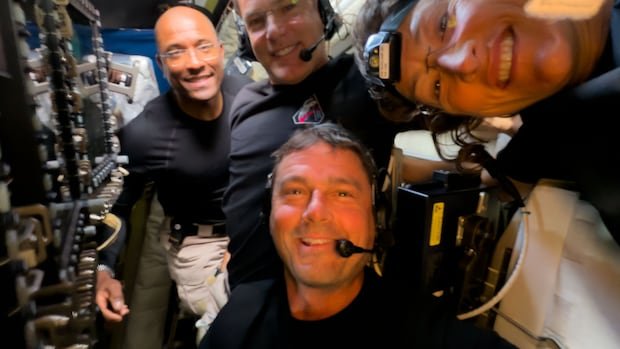

Canadian Space Agency astronaut Jeremy Hansen, alongside NASA astronauts Reid Wiseman, Victor Glover, and Christina Koch, have safely returned from a groundbreaking mission circling the moon. Setting a new record for the farthest human travel at 406,771 kilometers, surpassing Apollo 13’s 1970 record, the team’s journey involved a mix of scientific observations, medical experiments, and physical exercise.
This voyage, known as Artemis II, served as a trial run for testing the Orion spacecraft and its functionalities. The mission was not all smooth sailing, with some noteworthy events along the way.
One challenge encountered was with the newly installed Universal Waste Management System, colloquially referred to as the space toilet, experiencing initial malfunctions. Despite astronaut Koch successfully troubleshooting the issue by essentially rebooting the system, further complications arose during the mission, particularly concerning frozen urine extraction lines in the vacuum of space.
In a touching moment, the crew chose to commemorate the mission by naming lunar craters “Integrity” after their capsule and “Carroll” in honor of astronaut Wiseman’s late wife. This emotional gesture highlighted the human aspect of the journey.
The mission also focused on scientific endeavors, including health experiments and spacecraft testing. The highlight was the lunar flyby, where the crew observed 30 lunar targets from a distance of 6,545 kilometers. They provided detailed observations to the science team, including unexpected sightings of meteoroids impacting the lunar surface.
Upon their return, the astronauts will undergo medical evaluations and debriefings at the Johnson Space Center in Houston. Scientists will analyze the mission’s experiments and spacecraft performance to inform future missions. NASA’s upcoming plans include Artemis III in 2027, which will now serve as a lunar lander test in Earth orbit, with Artemis IV slated for human return to the moon by 2028.