
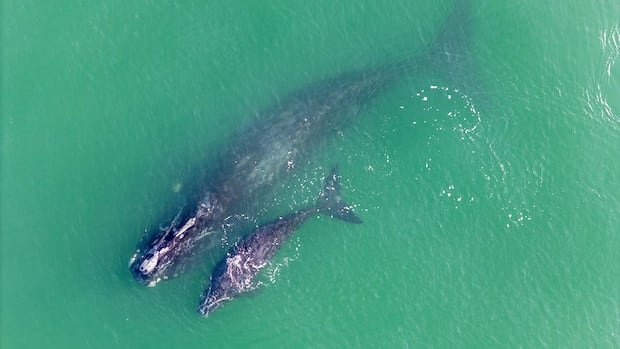

North Atlantic right whale experts on both sides of the border express cautious optimism following an increase in new calf births this year. A total of 23 calves were welcomed during the calving season from November to April off the southeastern U.S., marking the highest count since 2009. Amy Warren, a scientific program officer at the New England Aquarium’s Anderson Cabot Center for Ocean Life, described the 23 calves as a hopeful sign, emphasizing the importance of their survival into adulthood to bolster the population.
The North Atlantic right whales are classified as critically endangered, with only 380 remaining globally as of the latest official estimate in 2024. Over the past few decades, the annual calf birth rate has fluctuated. While approximately 20 calves were born each year two to three decades ago, the numbers dwindled in recent years, with averages falling to around 10 to 15 calves annually. Notably, in 2018, no known calves were born, underlining the significance of sustained positive trends.
Warren highlighted that the reasons behind the uptick in calf births this year remain uncertain, but the well-being of the mothers plays a crucial role. Factors such as access to sufficient food resources influence the health of North Atlantic right whales. These whales primarily feed on specific types of plankton, and changes in climate have led to shifts in their food sources, pushing them further north. Consequently, during calving, nursing, and migration to feeding areas, the whales struggle to find food in their traditional grounds off Florida and Georgia.
Moreover, Warren emphasized that mothers must accumulate enough fat reserves to sustain themselves for nearly six months without feeding while caring for their calves. External stressors like ocean noise, ship traffic, vessel collisions, and entanglements in fishing gear further impact the well-being of North Atlantic right whales. In recent years, conservation efforts have been implemented in Canadian and U.S. waters to protect these whales, including fishery closures and speed restrictions for marine vessels.
Delphine Durette-Morin, an associate scientist and research manager at the Canadian Whale Institute, suggested that these protective measures might have contributed to the observed baby boom. This year, not only did the whales produce more calves, but some mothers also exhibited shorter intervals between giving birth to their previous offspring and the new calves, indicating positive developments in the population.
While the 23 new calves bring hope, Warren reiterated the fragile status of the North Atlantic right whale population. She stressed that despite the increase, the overall population size remains critically low compared to historical numbers. Looking ahead, achieving sustained growth in the whale population would require a more significant and consistent increase in calf births over several years.
Durette-Morin viewed this year’s rise in calf births as a positive sign but noted that a substantial and prolonged upsurge, with approximately 50 calves annually, would be necessary to reverse the population decline. The whales’ movement northward was also highlighted, with sightings in the Gulf of St. Lawrence marking a significant expansion of their range this year. Researchers remain hopeful for continued positive trends in the North Atlantic right whale population as efforts to protect and conserve these majestic creatures persist.