
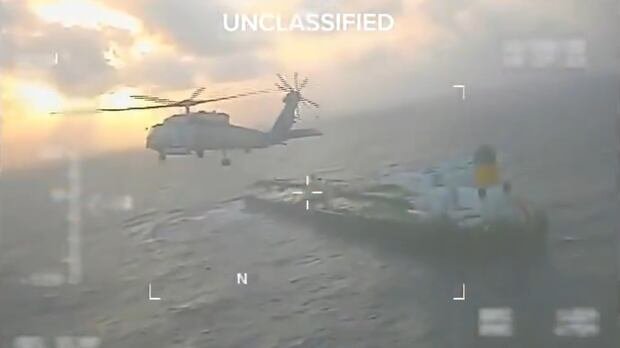

The U.S. government has taken control of an oil tanker near Venezuela in international waters, as confirmed by U.S. Homeland Security Secretary Kristi Noem. This action follows President Donald Trump’s recent declaration of a “blockade” on all sanctioned oil tankers entering or leaving Venezuela. Notably, this is the second instance in a short period where the U.S. has seized a tanker in proximity to Venezuela, coinciding with a significant U.S. military presence in the area.
Secretary Noem stated that the U.S. Coast Guard apprehended a tanker that had previously been docked in Venezuela. She emphasized the U.S.’s commitment to combatting the illicit movement of sanctioned oil used to finance narco-terrorism in the region. The White House, the Coast Guard, and the Pentagon referred inquiries to each other, with Venezuela’s oil ministry and state oil company PDVSA not providing immediate comments.
The seized vessel, believed to be the Panama-flagged Centuries by British maritime risk management company Vanguard, was intercepted east of Barbados in the Caribbean Sea. Jeremy Paner, a partner at a Washington, D.C. law firm and a former U.S. Office of Foreign Assets Control investigator, noted that the vessel was not sanctioned by the U.S. Paner highlighted that this seizure reflects an escalation of pressure by the Trump administration on Venezuela, contradicting Trump’s prior statement on imposing a blockade on all sanctioned oil tankers.
In a recent development, Trump called for a “complete blockade” of all sanctioned oil tankers entering or exiting Venezuela. Following the recent seizure of a sanctioned oil tanker off Venezuela’s coast, there has been an effective embargo in place, leading loaded vessels to remain in Venezuelan waters to avoid confiscation. Since the initial seizure, Venezuelan crude exports have notably declined.
Despite some vessels transporting Venezuelan oil being under sanctions, companies like U.S.-based Chevron continue to transport Venezuelan oil using authorized ships. China, the largest buyer of Venezuelan crude, receives approximately four percent of its imports from Venezuela. Analysts predict that if the embargo persists, the loss of nearly a million barrels per day of crude supply could drive oil prices higher.
Since the U.S. imposed energy sanctions on Venezuela in 2019, traders and refiners have resorted to a “shadow fleet” of tankers to transport Venezuelan oil discreetly. The vessel Centuries, part of this shadow fleet, was carrying Venezuelan Merey crude oil bound for China. Maduro, Venezuela’s President, has accused the U.S. of escalating tensions with the aim of seizing control of the country’s oil resources, which are among the world’s largest crude reserves.