

Marine biologist Emily Yeager recently shared insights on a peculiar behavior observed in suckerfish, also known as remoras, during an interview. These small fish are known for hitching rides on larger marine animals like sharks, whales, and manta rays, feeding on parasites in exchange for transportation. However, a new study led by Yeager suggests that this relationship may have a downside for manta rays.
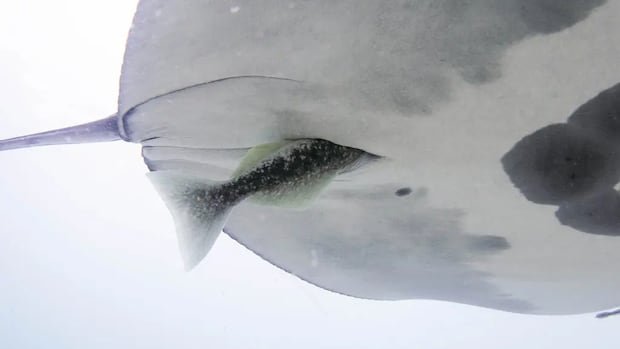
Yeager’s research, published in the journal Ecology and Evolution, highlights a phenomenon termed “cloacal diving,” where remoras insert themselves into the cloaca of their hosts, which serves as a multifunctional orifice for reproduction and excretion. While such behavior has been noted between remoras and whale sharks in the past, this study presents the first documented evidence of this interaction between remoras and manta rays.
The study documented seven instances of cloacal diving across various ocean regions over 15 years, indicating that this behavior might be more prevalent than observed. Yeager suggests that the remoras’ actions could be triggered by fear, as seen in a video where a remora swiftly enters a manta ray’s cloaca after being startled by a diver, causing the ray to react violently before resuming its course.
Brooke Flammang, a biological sciences professor, speculates that the remoras might engage in this behavior to scavenge for food, a practice known as coprophagy or consuming feces. Despite the unusual nature of this behavior, Flammang notes that remoras can be territorial and competitive when vying for space on a host.
While the exact impact of cloacal diving on manta rays remains uncertain, Yeager raises concerns about potential skin damage and reproductive complications that could arise from such interactions. This behavior challenges the traditional categorization of relationships between species as solely symbiotic or commensal, suggesting that nature’s interactions are more complex and diverse than previously thought.